


One important way to judge a potential nursery is by reading recent Ofsted reports. In nurseries, Ofsted evaluates a range of factors including child safety, education quality, and general development and support.
As a result, it’s important that you properly understand nursery Ofsted reports as you read them, as this allows you to gain professional insight into the day-to-day workings of the nursery, possibly before you even attend your first viewing.
What actually happens during an Ofsted inspection at a nursery?

When Ofsted inspectors visit a nursery, they run through a number of procedures and activities over the course of the day. The aim is to assess a variety of aspects of the approach and techniques used within the nursery:
- General observations – Inspectors oversee interactions between staff and children to assess teaching and learning quality, with a focus on how the nursery staff encourage development for children.
- Joint observations – Inspectors may observe alongside the nursery manager, asking them questions and comparing observations against policy to check for consistency and get a real understanding of daily routines.
- Feedback from parents – Inspectors often talk to parents during pick-up and drop-off to get their opinions on care and communication, as well as to identify areas of concern.
- Staff discussions – Ofsted inspectors hold interviews with members of staff to assess their understanding of important policies and to learn how well they apply the nursery ethos and values and nursery curriculum.
Ofsted inspectors are also required to review safeguarding, recruitment and risk assessment documentaries to check for compliance.
Tour a Tiddlywinks Nursery
Book in TodayHow often will a nursery have an Ofsted inspection?
The regularity of Ofsted inspections for nurseries varied depending on a number of factors. Firstly, newly registered nurseries are generally inspected within the first 18 to 30 months.
Beyond this, routine inspections follow every four years by default, though nurseries with low grades such as ‘needs attention’ or ‘urgent improvement’ are prioritised for another inspection within 6 to 12 months.
How to review a nurseries Ofsted report as a parent
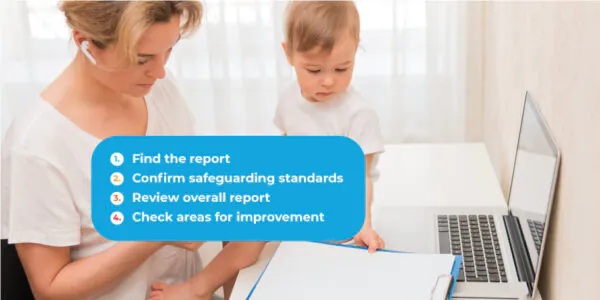
Reviewing a nurseries Ofsted report as a parent should involve assessing them based on safeguarding, areas for improvement and more:
- Find the report – Find the report on the Ofsted website by searching for the nursery name or postcode.
- Confirm safeguarding standards – General safeguarding standards are the basis of any successful nursery, so check these are marked as ‘met’ initially.
- Review overall report – Read every section of the report, looking out for potential pain points or ‘areas of improvement’, as well as assessing how the nurseries’ strong points align with what you prioritise for your child.
- Check areas for improvement – Most Ofsted reports, even ‘outstanding’ ones, have some areas for improvement. These tend to be more minor things which won’t be much of a worry, but scan for any areas which you think could be detrimental to your child’s development, and prepare to ask questions when visiting the nursery.
Key updates to Ofsted inspections in nurseries and childcare settings
In November 2025, Ofsted implemented some major changes to early years and childcare inspections. The idea of these changes was to move away from reports which essentially give single word effectiveness grades, and towards a more detailed system laid out like a detailed report card. The frequency of inspections was also changed from every 6 years to every 4 years by default.
Initially, single grades of from outstanding to inadequate are being replaced by a 5-point grading scale which is designed to be more reflective of the quality of care:
- Exceptional
- Strong standard
- Expected standard (the new benchmark for quality care, regarded as higher than the old ‘good’ rating)
- Needs attention
- Urgent improvement
The areas of evaluation are defined as follows:
- Inclusion
- Safeguarding
- Leadership and governance
- Curriculum and teaching
- Achievement
- Behaviour and attitudes
- Children’s welfare
Inclusion has been added as a standalone area of focus, assessing whether a provider supports all children equally, including those with special educational needs, disadvantaged children, and children in social care.
Even though inclusion is now standalone, the full scope of inclusion (including Special Educational Needs, family income criteria, and Looked After Children) is threaded throughout the whole toolkit that nurseries should be following. Every aspect of the report has an inclusive angle to it.
Additionally, inspectors are now instructed to use ‘shared observations’ with leaders and members of staff, encouraging ongoing professional dialogue to discuss policies and approaches.
Book a Tiddlywinks Nursery Visit
Speak to UsWhere can you find an Ofsted nursery inspection report?
To find the Ofsted report for a nursery, you usually have to go through the official Ofsted reports website and search for a specific nursery by name or postcode.
At Tiddlywinks, we are proud to display our Ofsted results, and have our reports published on each of our Nursery location pages.
Alternatively, if you can’t find a copy of the report online, you can ask the nursery directly for a copy, as they are required to provide it.